Tuesday, June 10, 2014

As I watch the Arabs flying by on the racehorses at the outdoor hippodrome near Abeche in Eastern Chad my mind quickly drifts back to the strange events that led up to my being here in this moment in time...

In November, when I was on a trip to evaluate the Adventist Hospital in Batouri, Cameroon, I received word that Olen's Uncle Scott wouldn't be going to the Koza Adventist Hospital in Northern Cameroon after all.  It appears that the extremist group, Boko Haram, from Nigeria crossed the border, kidnapped a French priest in Koza and took him back to Nigeria as a hostage.  Scott and his wife Bekki no longer felt it was safe to go to Koza.  Many emails and adjustments later, Scott and Bekki found themselves in Moundou near the beginning of January and Sarah and I found ourselves preparing to leave Moundou and move permanently to Abeche, near the Sudanese border.

After working for a month with Scott in Moundou, I got up one morning to drive to Abeche to start the preparations for moving out there.  That morning, I suddenly decided to drive the ambulance out there instead of our Vanagon. I drove to N'Djamena on Tuesday and participated in an AHI board meeting that evening.  At the meeting, when I told one of the board members that I was thinking of passing through Ati on my way to Abeche, he said I'd never find the route on my own, but I should wait and caravan up with the ADRA truck which would be leaving late in the morning Wednesday. 


The road to Ati and then on to Oum Hadjar on Thursday left me exhausted and the ambulance a little beat up.  I was accompanied by a friend named Abraham.  We lost a hubcap, the speaker for the siren and horn, and some pieces of old antennas on the roof that got ripped out trying to park the ambulance at night in a closed compound with a gate just one inch too low.

Friday, after meeting with the mayor and local health authorities, Abraham and I went to meet a British woman named Jill who has been working with a literacy program for the local nomads for years.  Sarah put me in contact with her.  Friday afternoon, as we sat around chatting on the mats, a friend of Jill's, Abunaga, came to visit with his son.  He had some property for sale and heard I was interested.  He was on his way to Mangalme but told me he'd be back Monday or Tuesday if I was still around.  I assured him I would be and we parted ways.


Saturday Abraham and I went to Abougoudam to visit the village where the dome hospital is in the long process of being built.  We slept next to the quad dome which will eventually be the OR and woke up Sunday morning to a group of people waiting around to see me.  They heard that a doctor was there and so I spent the morning seeing over 50 patients in the back of the ambulance, doing ultrasounds, referring for surgery and passing out meds. Meanwhile, Abraham discussed with the locals all that would be needed to plaster the domes using a local plaster mad of clay, sand and animal dung.


Saturday and Sunday, Abunaga called several times with us eventually setting up a meeting with him in Abeche around 3pm.  When the time came, we called him and he told us he would be on a horse by the side of the road.  We found Abunaga on top of a beautiful Sudanese Arabian stallion.  He thought we were also immediately interested in a horse and offered to sell us this one for $2000.

"Sorry," I told him in Arabic. "We're not currently interested in a horse, just land."

"No problem, " Abunaga replied. "I'll meet you tomorrow at 7am here.  I can't show you any property now because I'm taking this horse over to the races."

"When are the races and where?" asked Abraham.

"Four in the afternoon," Abunage informed us and then went on to explain where they were.


Abraham and I returned to our friends' house in Abeche where two youths agreed to take us to where the racetrack was.  We filled up with a little diesel and then wound our way through the brick-making yard on the outskirts of town just past the university.  The road twisted and turned through a wadi filled with piles of bricks in various stages of development: from piles of manure to men mixing the clay and manure to pits covered with tarps and filled with water from workers slapping the mix into molds to young guys lining them up to dry to others carrying piles between two of them on a litter up to the ones stacking them in square pyramids for firing with round palm nuggets used for fuel.  I felt I was back in Egypt during the period of the Israelite captivity and slavery.

Finally, we got to the outskirts of the brickyard and found the traces of a 1200m track with a wall on one side and a sort of bleachers with brick and cement benches covered with a tarp haphazardly attached over some twisted sticks. I parked the ambulance under the shade of a large tree in the middle of the track and we march back to the bleachers.


So I find myself watching the first race of 8 horses and jockeys fly by the stands and round the corner out of sight.  One horse takes the initial lead and never gives it up, winning easily by 5 lengths.  As the second batch of horses lines up for the next and final race, one of the announcers calls Abraham over where he consults with some of the organizers of the event.  The next thing I know, the MC is thanking me over the load speaker for bringing the ambulance to help them in case of injuries.  I wave to the crowd as they clap and Abraham tells me that they'd like to have a permanent relationship with me and the ambulance and that maybe I can drive it behind the racehorses so that if a jockey takes a tumble and is injured i can dress his wounds and/or take him to the hospital.


The second group of 5 horses and jockeys trots off the the left to the starting line.  Four of the horses line up but the fifth jockey can't get his horse back on the track into the lineup.  Finally, the turbaned arab officiating just waves the white towel in front of us and the four horses blast off at full gallop soon passing right in front of us.  I'm filming them with my phone just until they all but disappear around the bend in a cloud of dust.  As I pull my eyes of the phone's screen I see the fifth horse has finally made it on the track and the jockey is whipping it mercilessly as he desperately tries to catch the pack.  Just past us he gets too close to the mound of earth marking the interior border of the track and his horse stumbles, taking him down and rolling over him.  The horse quickly gets up and trots off.  The jockey lies there motionless.  Everyone is stunned and immobilized for a split second then people start breaking off the stands and running towards the fallen hero.

I feel since they just announced that I'm a doctor and have the ambulance there for them that I should do something so I jog over as best I can in a long, flowing Arab robe.  By the time I get there, the man is squeezed in a mass of humanity.  I manage to push my way through in time to see someone has grabbed him  by the neck and his pulling and jerking his head upwards with one hand under the chin.  His arms are flailing and he has a crazed, dazed look in his eyes.  I try to get them to put him down and give him some air but the place has gone crazy with 10 different people saying 10 different things and doing 10 different maneuvers.  I finally give up as the dust is starting to choke me from the mob.

Finally a morbidly obese man pushes through on one side and grabs the injured man's legs while a skinny guy pushes through from the other side threatening to stab anyone who gets in his way and with the help of a few other hands they grapple the man into the air and run off with him across the track.  I'm just standing there stunned when a man comes up and tells me to go get our ambulance.  I half run over and as I open the door to the ambulance, a Toyota Hilux pick up whips up and they drag the man out of the back seat and toss him in the back of the ambulance.

I flip on the lights and sirens and take off across the field, cross the track, try to avoid the straggling crowd and whip around the stacks of bricks following a car and several motorcycles that seem to be heading back to Abeche.  I whip off the dirt and across the paved road, trying as best I can to dodge the ubiquitous three wheeled motorized rickshaw taxis and motorcycles.  I fly through town, mercifully avoiding the other vehicles and several animals and then take a sharp left that plunges me into a market.  I feel like I'm in an Indiana Jones movies as people dive left and right to get out of the way.  I cross a speed bump and fly through the gate into the hospital.  The ER is just on the left and as I open the ambulance bay a group of nurses is already there with a gurney.

A crowd of Arabs is trying to push there way in the ER as the hospital staff tries valiantly to keep them out while letting me slip in.  I tell the staff what happened.  The man is complaining of left sided chest and flank pain but is in no immediate distress.  I ask if they have xray and ultrasound available.

"Not until tomorrow morning," says one large female nurse.

"Well, not ultrasound," contradicts a tall male nurse. "But we can call in x-ray."

"What about lab?" I ask.

"Sure, no problem."

"Ok, I'll go get the ultrasound I have in the ambulance if you can call in x-ray," I order even though I have no authority to do so.

I bring in the portable ultrasound.  I put it over his spleen and don't see any obvious intra-abdominal fluid, but there might be a little something?  It's so early, I can't say he doesn't have a splenic injury.

"Do the xray if you can," I turn to the nurses. "If he starts having serious respiratory distress, put an 18 gauge IV catheter right here over the second rip just in line with the nipple and you'll save his life.  Do a hemoglobin now and in the morning.  If his belly starts to swell or he has any other problems he'll probably need immediate surgery."

"Will you come and read the x-ray?" asks the tall nurse.

"No, that's not necessary," interrupts a second nurse. "The doctor on call will read it."

"No problem," I say. "But here's my name and number if you need it, don't hesitate to give me a call."

I scribble the info on a piece of paper and Abraham and I go back home.  We eat a good supper of grilled goat, bread, and salad and then watch a bad Jean Claude Van Damme film with the young guys we're sharing a room with. When the movie is mercifully over, I turn to Abraham.

"We should go see the patient, see how he's doing." I'm a little worried about him and don't trust the government hospital to watch him closely enough.

"Yes, that's a good idea, let's go," replies Abraham.

We arrive in the ambulance within five minutes and go into the ER.  I find the tall male nurse sitting at a desk consulting another patient.

"As salaam aleikum," I greet in Arabic and then continue in French. "We've just come back to see our patient."

"The family decided to take him home just after the house officer saw him and prescribed his treatment, sorry."

I'm disappointed and a little mad, but not surprised that the family has no faith in the government hospital.  "Ok, what can we do?  Everyone is free to do what they want.  Au revoir!"

"Merci, au revoir."

And Abraham and I walk out.

Monday, January 2, 2012

ADAM

The moon has gone down. I walk in the dark with only the stars and the promises of yore to light my way. I make my way past the silent benches that all day held crowds singing in French and Nangjere as the drums pounded out their mournful beat. My body is as limp as the pillow I carry. Every last tear has been wrung from my eyes. I make my quiet pilgrimage to the site of my greatest sorrow. I enter the room that holds so many memories. As I open the rickety lock I remember locking that same door from inside as I cared for two little African babies struggling for their lives while outside men fought to end each others. The faint odor of bat guano greets my nostrils and makes me think of the time the winged mammal hit the fan and landed on the face of the baby fighting for breathe in the clutches of an asthma attack. I shine my light on the IV slowly dripping into the arm of my sweet little daughter, Miriam, as she tosses and turns in a fitful slumber. Sarah lies by her side in the mosquito net softly comforting her one remaining child. It seems like an eternity already since the morning when two babies wiggled and squirmed and flipped and grinned and giggled and squealed together in that same tent.

Sarah woke me up less than 24 hours ago. "The twins are really active and I'm
having a hard time. Can you come over?" I arrived to see Adam staring at me
with a silly grin right before flipping off the mattress between it and the net
and letting off a howl of frustration.

"You should have seen them. They both woke up, looked across the mat, grinned
and tried desperately to crawl to each other," said Sarah.

We'd arrived in Bere the day before. Thursday night, Adam had a fever of 104.
We were in N'Djamena and I bought a rapid malaria test. It was negative. I wasn't convinced. I opened a capsule of Artemesia, poured it on his mashed sweet potatoes and fed him despite his obvious preference for medicine-less food. The next morning, I fed him another dose and we loaded up the scalded dog and were on our way to Bere by 6:30am. By 2:30pm, both Adam and Miriam had been diagnosed with Falciparum malaria and started on IV Quinine. Through the night, they each got two of the every 8 hour doses.

I start Miriam's next IV perfusion and turn to Adam. I let 150 mL of 10%
glucose solution run from the IV bottle into the pediatric reservoir on his IV
tubing. The tubing has special air traps to avoid any accidental entry of air
into Adam's veins. I pull out 0.5mL to flush his IV and then carefully measur
90mg (0.3mL) of quinine and inject it into the top of the reservoir of 150mL. I
open up the IV, see that it was running well and slow it down to a drip.

I turn to look at Miriam and talk to Sarah.

"Is that a seizure?" Sarah interrupts our conversation and we turn to look at
Adam. He's not breathing. We start CPR. I run and get some 50% glucose
solution, afraid of low blood sugar. I text Olen who is there in minutes.
Still no breathing. Olen confirms a heartbeat, slow and irregular, but there.
Olen gets a bag valve mask and starts breathing for him while I do chest
compressions and Sarah continues to give glucose. Anatole arrives and checks
the blood sugar. It's high from all the glucose we've been giving him. We try
Adrenaline in ever increasing doses. His heartbeat never picks up. Every once
in a while he grimaces, groans, struggles for a couple breathes, giving us hope.
We work on him for over an hour. His heartbeat disappears. His pupils are
fixed and dilated. I'm praying desperately for a miracle. We stop.

Deja vu.

How many years ago did the same thing happen to my friend Gary and his little
boy Caleb?

It's 8:00 am and my life has suddenly changed for the worse. Sarah and I hold
Adam's still warm body. I desperately kiss his neck, my tears know no bounds.
My cries echo across the campus to join the thousands of others I've heard over
the years in this corner of Africa. Will I never again see his tongue half
hanging out of his silly grin? Will he never again wrap his legs around my
arms, brining my fingers to his mouth as he softly coos? Will he never again
thrash his arms in legs while staring at me with a look of pride and joy? Will
he never again take up the airplane position looking around for confirmation of
his abilities? Not in this life.

A day long ritual of African mourning begins as the news spreads like wildfire
through the village. People come to offer their condolences. Miriam becomes
agitated with all the visitors. I wrap Adam's body in my green and black
checked Arabic head scarf and carry him over to the house where friends have
arranged to let the mourners come in and visit. All day long the songs sung in
rhythmic Nangjere drift in as people make their way to where I am sitting on a
thin Nigerian mattress. So many people, so much collective pain and loss.
Salomon comes in and hugs me. A flood of tears bursts forth as I remember him
holding Adam so many times as we ate together in Moundou, enjoying one of his
famous sauces. Frederic kneels down and holds my hand long and hard in an
undulating shake of sympathy. Just last year I was at his house as he held his
son who had just died. The mother of the boy across the street who fell down a
well and died crouches and holds my hand as we share tears of sorrow and she
offers words of comfort and hope.

The steady stream of people brings me a steady stream of tears as I shake and
hold the black calloused hands of so many people who's lives have been filled
with loss. The strength of the grip and the power of the muscular arms of both
men and women combined with their roughened feet tell a thousand tales of woe.
Their is no awkwardness. They've done this before a thousand times. Tears come
from faces I've never seen before. But we now have a common bond of tragedy.
The only ones who seem uncomfortable are some of the westerners, but their warm
embraces make up for the lack of familiarity with death.

Gary and Wendy fly in from Zakouma just in time for the English portion of the
day long wake. Hymns of hope sung gently and powerfully by the many musicians
in our group of Nasaras warm my soul as Sarah holds Adam's now cold and
stiffening body.

"When the trumpet of the Lord shall sound and time shall be no more...when the
roll is called up yonder I'll be there." The rollicking song brings bursts of
tears from Gary, Wendy, Sarah and I as we remember Caleb's favorite song and the
other little foreigner buried in Bere what seems like ages ago. Now it's time
for last good byes. Sarah and I bring Adam's long little body into the house
and place it gently in the casket made by Jamie just this morning. I kiss his
cold brow one last time and we put on the lid.

The pathfinders are outside to carry the body to the grave site. Under a little
tree in front of our old house in Bere lies a volcanic stone with a little
plaque that says "Dinah Bindesboll Appel". Next to it is a deep, rectangular
hole waiting for our second child to return to the African dust. Noel gives a
stirring eulogy reminding us of the day when God will say "Viens" to both death
and the devil and both will be done away with forever. Then God will turn to
Sarah and James and say, "Here's Adam." And to Gary and Wendy, "Here's Caleb."
And the innocents will be restored to their rightful place.

But for now, we miss him terribly...

RIP Adam David Bindesboll Appel, June 25-December 31, 2011


Friday, December 24, 2010

Planes, Trains, and Automobiles

It's surprisingly cold for a Chadian morning. I'm glad for the fleece that Olen has lent me. I swing my backpack filled with Christmas gifts onto my back, grab my computer bag and head out to where Jonathan has left us his motorcycle.


Olen tries to start the bike unsuccessfully. The ignition is hanging down to the side by it's wires and despite all our efforts it won't start. Even Frederic can't get it going. Finally, the engine sputters to life only to die within a few seconds. In the ensuing silence we hear the sounds of the "scalded dog" rumbling up the road from Bendele. Gary is borrowing the Toyota minivan to go to Moundou so he gives us a ride to the market.

I sit on a wooden bench as the bush bus taxi roars up from Lai, swinging from side to side. There is a mad rush for the door as there are only five places and about twenty of us waiting.

"Hey, we have tickets since yesterday!" I shout out in French to the man holding the list.

"Ca c'est vrai," he replies and makes everyone come back out. He reads of the list and my name is first on the list followed closely by Philip's. I squeeze down the aisle to a seat that has been rigged to fold down into the corridor with a tiny seat back that folds up. It's worn and the padding has all but disappeared. If I shift my weight around I can almost get my butt off the metal poles making up the skeleton of the chair. It's going to be a long trip.

A large woman pushes down the aisle making me stand up and lift the seat to let her in behind me. She is yelling in Nangjere that she can't sit there, it's broken. Many people yell back until she grudgingly accepts her fate and plops in behind me. A toothless man bangs on the window. Tobacco breath pours into the bus as he tells me to give him money to put my bags on top. I start yelling back and move out the crowded bus to the outside where I lift my bag up to the roof rack myself as the crazy man yells to his colleague not to tie it on and the chauffeur yells at me to get back in and let him handle it.

As we get bouncing down the dirt road to Kelo, I have a pleasant conversation with Philip about his film project on Samedi and his plans for the future. In Bongor we stop for a 15 minutes. I cross the road, avoiding the weaving motos. I buy two yogurts in small plastic bottles. As we get moving again, the fat woman behind me asks me in Nangjere if she can have it when I'm done. I give it to her. When Philip finishes his yogurt, the beautiful, thin girl sitting next to me asks for it almost causing a small war between her and the fat woman who wanted both.

In N'Djamena, I jump off and head for the latrine. My bladder is about to explode. The hole in the ground is no longer a hole. It is completely filled with human waste and urine is lying in puddles around the edge and flowing out under the tin roof nailed haphazardly on as a door. I empty my bladder and get out of there as fast as possible. Philip and I sit in a bench in the shade drinking cold Hibiscus tea as we wait for Fatchou.

Dr. Fatchou walks up with a big smile on his dark, wrinkled face and begins talking a thousand miles an hour about all his projects as he hustles us into to his beat up Camry. We drive around Chad's capital as he shows us his old office at the National Leper Program and his new one down by the river. FInally, he drops us off at Farcha at David and Sarah the Swede's house/cheese factory.

Sarah greets us and invites us in to some cold meat and french fries left over from their lunch which we devour. On TV that night I see that a huge snowstorm has closed or limited flights to many European airports including Paris, Copenhagen and Frankfurt. Not good news for my plans for tomorrow. I sleep well despite the incessant barking of the dogs and the dive bombing of mosquitos in my ears. The next morning one of David's workers takes me around on a moto. I'm supposed to meet the DIrector of the Organization of Health Services in Chad. He shows up an hour and fifteen minutes late to our meeting. Good thing I was 30 minutes late so I didn't have to wait long. After hearing a 30 minute diatribe on national politics I turn in the papers for the Moundou Surgery Center, remind him of his promise to go on a mission to see our problematic Distric Medical Officer and ask a question about our project in Eastern Chad.

I hand in the photocopies of mine, Gary and Jonathan's passports to Aime so he can help us get authorization to fly to the Chad side of Darfur where the Sultan has invited us to reopen some medical work there. Now I have barely enough time to catch my plane. I tear off my Arabic Djallabiya, put on pants and a t-shirt, grab my back pack and computer bag again and Sarah drops us off at the airport.

In the line out Chad's one international gate I spot a short Phillipino girl I recognize! Caitlin was a volunteer at the Koza Hospital who I met just a few weeks ago. We chat and I find out she's heading to England before going to Bangladesh. In Addis Abeba I part ways with Philip who's headed to Washington, D.C. and Caitlin. I wander the airport and watch a movie to make the 5 hour layover pass quicker. My flight to Rome leaves at 20 minutes after midnight. I spend the 4 hours talking about Africa and NGO's and what kind of hope is there with a Swedish girl working for Unicef and an Indian businessman from Zanzibar.

In Rome I realize I not only don't have a ticket for the rest of my trip but I don't even know what airline I'm on. Sarah's brother Kim bought the tickets and the next leg is either at 9:35 to Zurich or at 12:15 to somewhere in Germany. I try SwissAir first but they have no reservations for me. I then try Lufthansa but they can't find me on flights either to Frankfurt or Zurich. Finally, they find me on a flight to Munich at noon. The agent with the cute Italian accent comes to help me check in at the automatic check in modules. Suddenly, as if having a brilliant idea, she turns to me and asks me if I'd like to go to Munich now. There's a flight leaving at 6:10 and if I hurry I can make it.


I run, barely catch the flight and find myself descending into Germany at a little after 8am as the sun is just barely sneaking over the snow capped peaks illuminating the snow dusted fields and rooftops of Munich. Inside the airport, I find a flight to Copenhagen that leaves at 10:45am. My flight is scheduled for 2:30pm. I head to the gate. The woman at the counter is not too optimistic.

"We usually can't modify this type of ticket," the woman says in English with just the slightest German accent. "But I'll see what I can do."

Munich has free hot chocolote, hot milk or hot coffee and not having eaten breakfast I down about 10 cups of hot chocolate mixed with hot milk. And I wait. The woman calls me up to the counter.

"I've put you on standby, but just leave the ticket here."

I go back down to sit. Soon the flight is delayed, not due to snow like I'd expect since 30% of flights into Copenhagen have been canceled, but rather due to "technical problems." The woman motions me back up to the counter.

"I've given you a seat, but just leave the boarding pass here, I need to..." Her voice wanders off. She seems distracted. I thank her and go sit back down.

The plane keeps getting delayed. Finally, at 11:50 we're ready for boarding. I go up to the counter.

"Here's your ticket, but there are kids sitting around you and I'd like to get them all together. Just wait a minute." I sit back down again. I wonder if I'll actually get on the flight after all.

Finally, the woman motions for me to come back up. "I hope you don't mind, I had to put you in Business class."

Oh yes, I mind terribly. Give me my ticket! I think as I calmly reach out for the boarding pass and settle in comfortably for a well hydrated and well nourished flight to the land of the Vikings. Instead of being delayed like many European holiday travelers or even having my flight canceled, instead I arrive 4 hours earlier than scheduled!


My friend Henrik is there to pick me up and takes me to his apartment near the train station. I get a bite to eat finally for the first time that day. A cheese a red pepper sandwich with Thousand Island dressing has never tasted so good! Henrik, Pernille and I take the closest train to the main station where I buy a ticket for my 4 1/2 hour train ride to Aalborg.

I descend the elevators to Quay 7 and enter into the chaos of the holiday travel season complicated by record low temperatures and snow fall. The train pulls up 20 minutes late and a surge of humanity rushes the door creating a standstill that lasts almost half and hour as we push and struggle to get on the train bursting at the seams with Danes (and others) trying to get home for Christmas. If it had been 40 degrees Celsius warmer I'd have thought I was in a crowded Indian or African train station rather than a European one. I finally managed to wedge into the doorway, make it up the stairs and stand with my back pressed into the wall of the entryway. Suddenly, everyone starts rushing out, not in a panic but rather quickly. I hear a Dane speaking English and ask him what's going on.


"There's smoke, a fire maybe, it's ok, we have to get off." Just then Henrik and Pernille come back up and explain that now we have to evacuate the quay as well. The train station is now more crowded than ever and rush hour is about to start. Another announcement tells those of us without reserved seats to not get on a train but they'll send a bus. We go and change my ticket for one that leaves tomorrow at 6:50am and go back to the apartment. Pernille later finds out that her sister took 10 hours to travel to Vejle, a trip that normally takes 2 1/2 hours! Instead of spending my evening in stop and go traffic all night to northern Jutland I spend it wandering the beautiful, snow covered, Christmas decorated streets of Denmark's capital culminating in a magical promenade through Tivoli which has been transformed into a winter wonderland.


A good night's sleep behind me I step out into the dark streets of Copenhagen where a gently falling snow welcomes me. My face is almost frozen off by the time I walk to the train station and get on the train to Aalborg in normal, organized fashion. I don't have a seat, but there are three fold-down seats in front of the bathroom. One of them is occupied by a Ghanian girl who immigrated to Denmark 7 years ago and is now studying Optometry. We have a stimulating conversation about the positive and negative aspects of life in Africa versus the West. After 2 hours she gets off and I find a regular seat where I stretch out my legs, watch a couple movies and enjoy the snow covered farming scenes rushing by outside the window.

Kim, Sarah's brother, meets me at the train station in Aalborg.

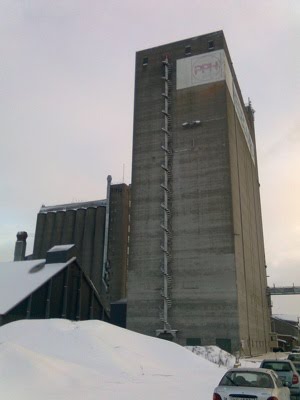
"James, this is Eva, a film student. We have to film something. It shouldn't take more than an hour and then I have some shopping to do. Then we'll go surprise Sarah." I jump into the car, glad to get out of the cold. Kim takes us to the edge of the fjord next to a cargo ship unloading grain into a 12 story silo. We take a tiny elevator to the top of the silo and enter a long room with pipes and rumbling machinery bringing the grain up and dumping it in the huge storage tanks. At the other end is a small door leading out to a spiral exit stairway and a fabulous view of North Jutland's largest city and industrial center. The fjord is iced over, but the ice is starting to crack leaving the surface like a kaleidoscope of ice chunks with tiny lines of dark green ocean in between.


Kim goes up and down while Eva films and then they switch places. My role is to try and stay warm as I wrap the scarf Henrik lent me tighter and tighter around my frostbitten, running nose as my glasses fog up. Finally, Kim goes to get his shopping done while I'm supposed to help Eva. This consists of my tired, hungry body going up and down 12 stories of snow covered stairs outside a concrete silo in below freezing weather (not counting the wind chill factor) not once, not twice but 2 1/2 times!


Finally, we head off the 40 minute car drive to Ostervra. We pull up outside Sarah's mom's apartment. The door is open. I don't knock. I'm in the entry way. The door to the living room is closed. I open it. I still don't see anyone. I go around the corner to the kitchen and there, stretched out on the couch, covered with a blanket facing me is a curly, red headed Dane. Her eyes widen. Her hands fly to her mouth.

"No way, are you serious? Is it really you?" She gasps in surprise, then in Danish tells her mom to come from the kitchen and see what's here.

And thus ends an incredible journey, and begins a very merry Christmas season indeed.


Saturday, December 11, 2010

Cold

I sit in the cold of a Cameroonian morning here in the mountains of Koza. The sunlight is beginning to stream through the dust covered windows, seeming to sift slowly to the floor with the ever present dust in the start of the dry season.

I wait. The lab guy should be coming any time. My body is weary and my back aches. Will I have to give blood or not? The result of the hematocrit will tell me. My mind wanders. Did yesterday really happen? It's kind of all blurred together. In my head, I'm back in the OR yesterday...

We're getting started late. I'm a little frustrated as I try to occupy my time straightening up the counter that serves as the anesthetist's work station. I'm alone with the patient stretched out on the bed barely covered with a skimpy hospital gown. This is going to be a long, tough surgery and it's already approaching noon. The system here is archaic. The patient's family must pay for the surgery, then go to the pharmacy and get all the supplies needed for the surgery since the OR has almost nothing there. Then they have to go to the lab to get tested and give blood. All this could've and should've been done yesterday or at least early this morning. Finally, the nurse himself had to go get the supplies because no one oriented the family members where to go and what to do.

Finally, I stand with scalpel poised in hand, flanked by two congolese doctors, Roger and Solomon. I start the incision in the old, midline c-section scar. I decide to repair the vesico-vaginal fistula first. Urine has been leaking from a hole in her bladder through her vagina for over a year since she was operated on in Maiduguri, Nigeria. Sometimes, after a difficult delivery or as a result of a surgery on the uterus, the bladder can be damaged creating what's called a fistula, or a hole so that the woman has no control over her urination, but leaks pee constantly.

I open the bladder and spot the fistula. I cut out the mucosa and free up the tissues and then close the deep vaginal layer, the bladder wall muscle and finally the mucosa of the bladder in three separate layers. I suture up the bladder and extend the abdominal incision all the way to her chest. My back is already starting to hurt as the ancient operating table will only raise itself so high, not nearly enough for a scrawny, six-foot-five man. I have to lean way in as I dissect the colon off the enlarged, non-functioning left kidney. It must have been chronically infected as well since there is a lot of inflammation that makes dissecting and identifying the ureter and the large blood vessels difficult.

After hours, I've finally mostly freed it up, but the blood vessels remains in a mass of inflammatory tissue. I've just damaged the kidney and it starts to bleed dark blood. A lot. I hold pressure and tell the staff to get the blood transfusion running. Ganava calmly tells me there's been a mistake, the family never actually gave blood, that was for the next patient. I'm incredulous. I would've never operated on such a big case without having blood available. I send Elissa running to the lab to check this patient's blood type and see if there's any blood from other surgeries left in the fridge.

After what seems like an eternity, Elissa comes back with the blood typing reagents and a bag of O + blood. Sure enough the woman is O + as well so we get one bag running. I release the compression on the kidney and dark blood wells up again. I send up a quick prayer and go for broke. I sweep my fingers behind the kidney and tear it loose from the adhesions holding it in until just a stalk remains attaching it to the circulatory system of the body. In that stalk is the vein and artery. I put a clamp across the whole mess and then a second one almost on the kidney and cut the kidney off and lift it out. The bleeding has stopped. I then leisurely double tie the blood vessels under the clamp, pull out all the gauze holding the intestines at bay, making sure to get them all and close up.


I do a hernia next and then we all eat for the first time since breakfast as Caitlin and Elissa have brought back some beans, rice, eggplant and dinner rolls from the house. They also have a case of Fanta and Coke. Since there's not bottle opener I try something I saw someone do once. I place the cap over a metal edge and hit the top of the bottle several times until I break off the glass. I gingerly drink from the now sharp edged bottle the renewing sugary mix.

The final case is a young 30 year-old-woman with advanced cervical cancer. I feel it's worth a shot at least in opening her up to see if the cancer is resectable. Since we don't have CAT scans or other ways to see the extent of the spread, an exploratory surgery is the only way. Unfortunately, I soon realize that the cancer has surrounded the ureters and blood vessels and started to erode into the bladder and rectum. By this time, she is oozing dark blood from many small wounds in the uterus that are two friable to suture. I hold pressure for a long time, but in some surgicel and a drain and close up. Fortunately, she has three bags of blood: two B+ corresponding with her blood type and one O+ that is also compatible. We get the first bag in quickly and get the second one running as we take her out to the hospital ward.

I go to see the first woman we operated on and she really needs more blood but there's none available except the one bag of O+ for the woman with the cancer. I make a tough decision. Both need the blood, but the woman with the cancer has an incurable disease. I go in to see the family. I explain that her cancer is inoperable and she has a few months to live at best. After some translation from French into Mafa they understand and express their thanks that we at least tried. I offer to pray for them and the nurse prays in Mafa. They all warmly shake my hand. I then explain that we are going to take the last bag of blood and give it to someone else. At first they resist, but finally agree after much time spent explaining.

I give the bag to the nurse and head home, weary, walking gingerly because of my back pain and ready for some Ibuprofen and a hard cold floor to stretch my back out on.

After a wonderful, but too short night's sleep I hear a knock on the door. The nurse needs my on the surgery ward. It's the woman with the cervical cancer. Her blood pressure is 90/50. That doesn't worry me to much. She is awake and alert, but her heartbeat is fast. Her conjunctiva are a little pale. The drain has put out over 200cc of blood overnight but her abdomen is soft. I prescribe IV fluids and tell them to call the lab guy for a hematocrit. I told him to come give me the results directly at home. If she needs blood, my B- blood will be the first bag she gets.


So I wait, in the cold, bare feet and short-sleeved to know my fate early this Saturday morning in the mountains of the Extreme North of Cameroon...


Sunday, December 5, 2010

AMA

In many ways, being in Cameroon is like a vacation. I came down from N'Djamena with Dr. Roger and Dr. Solomon, our two congolese doctors who'd just joined us in Chad but were chased off by the psychopathic behavior of our local District Medical Officer who threatened to throw them in jail the first day they arrived if he saw them in the hospital. It's been 6 weeks of running around trying to meet all the requirements he's listed despite the fact that the local Regional Medical Officer (his boss) and the governor gave the docs the ok to start practicing. Finally, since the Koza Hospital in Northern Cameroon has been without a doc for 3 months, I brought them here where we have been welcomed with open arms by all the local authorities, the hospital staff and the local church who all keep thanking God for answering their prayers and providing them with doctors so they don't have to refer c-sections an hour away over bumpy mountain roads to the nearest public hospital which is sketchy at best if they don't die en route.

So, I've felt an oppressive load fall off my shoulders, a load I wasn't even completely aware of until I was in an atmosphere where people were happy to have me and do everything to help rather than menace and threaten and coerce and intimidate. All in all, it's been embarrassing because in 7 years in Chad it's the first time I've ever had a real problem with a Chadian, and to have it happen when I finally find some young doctors willing to come and help me, it's discouraging as well. But, then again, Koza has it's own difficulties as well.

I walk into the surgery ward the first day in Koza. A young boy had fallen out of a tree 3 days ago and cut open his upper lip. I take off the bandage and see that the nurses have done an excellent job of suturing what seems to have been quite a complex laceration. I notice that besides his swollen face, the boy is favoring his right arm which is wrapped in some rags with sticks tied together in a splint around the entire forearm.

"Does he also have a broken arm?" I ask the nurse who rushes over to look.

"I don't know what that is, some traditional bone setter must have snuck in here last night. It wasn't there yesterday."

The boys' father, a short, man standing straight with a white skull cap and a dirty blue robe smiles pleasantly and confirms the nurses questionings.

I unwrap the arm to take a look. The arm slightly swollen and tender over the distal radius. It seems to be reduced well. A simple fracture.

"We can put a short arm cast on it for three weeks and it should heal fine." I get ready to move on, but the father says something harshly in Mafa, his mother tongue. I don't understand a word and look questioningly at the nurse who looks sheepish.

"He says, no plaster. He's had it once on his arm all the way to the shoulder, but he didn't bring the kid here for the broken bone, just the cut lip. The bone setter says that in two weeks he'll take off the sticks look at it and proclaim it healed so he prefers that. No plaster."

"Did the cast work for him when he broke his arm years ago?" The nurse translates for the father who smiles and nods while moving his arm briskly in all directions and flexing to show he has no problems as he spouts off some shotgun sentences in Mafa.

"He says he has no pain and can work all day in the fields for years...but no plaster for his son."

I spend about another 15 minutes trying to reason with the man who just keeps smiling and refusing the nice doctor who just doesn't have a clue about broken bones and how fast they can heal in the hands of the right witch doctor. I move on.

That evening I go to the ER to see a pregnant woman with high blood pressure. She says she is 8 months pregnant and has swelling in her legs. In fact, her legs are extremely edematous and she is hugely pregnant. I examine her belly and while she doesn't have pain or bleeding, i feel the fetal presenting parts so well I'm afraid of a ruptured uterus. She says she has been having contractions for 3 days. I bring out the ultrasound and find that there is no ruptured uterus, but rather two healthy twins at term. With the added complication of twins, the fact that they are at term and her pre-eclampsia, I decide the best thing is to do a c-section, take out the twins with as little risk as possible and treat the pre-eclampsia as well by removing the pregnancy.

I calmly call over the woman's mother and explain. She is categorically against it. She says they have to wait for the father and the husband. The husband is in Nigeria and the father is in the village 10 km away. I nurse asks her is she has a phone number. Yes, but her phone's battery is dead. I borrow a phone and try to call the husband. No answer. The nurse calls the father. No answer. I recommend the mother go get the father so we can operate tonight. 10km on a moto taxi is not far. She refuses. Says it's dangerous at night. I have them sign a paper saying they refused treatment and go home to sleep.

The next morning I see the woman and her mom. She says she went to the village but didn't bring back the father. Soon the husband shows up. He seems educated and understands my reasons for wanting to do a c-section but says without the father's ok, he can't agree to it. The mother told the nurse last night she doesn't understand why we want to operate. Her daughter is walking, eating, talking and doesn't seem sick. When asked why they came to the hospital then, she had no good answer.

Finally, later in the morning, they take the girl home. I find out later that they must have thought I was an idiot since I tried to show them the edemas and blood pressure to show that the girl was really sick. Apparently, one nurse told me that night at the house, the Mafa know that if you have edemas, it's because you're going to have twins. So I was trying to tell them the edemas were caused by a sickness when they knew perfectly well it was just the twin pregnancy that caused that and that obviously I didn't know a thing and couldn't be trusted.

That same night, I see a 13 year old girl with classic symptoms and signs of acute appendicitis. I sit the father down on a bench in the ER in front of the nurse who translates as the girl writhes in pain on the bed behind me. The father listens attentively and then tells me that she has worms, maybe tenia, and that she needs some good bark or roots. I explain again. He says, ok, just give her some pills tonight and we'll see how she does tomorrow. I'd already started an IV and I pointed out that she was still in obvious pain. He countered with the fact that it was probably because she was sneaking off with some boy getting pregnant or something. Another wasted half and hour later and I go home as the father insists that the nurse take out the IV and let them take her home where she can get some appropriate witchdoctor cure for what ails her.

At least one story has a happy ending as the next morning the other family members bring the girl back saying she was crying all night long and they want her to be operated on which we do without complications and send her off to a hopefully speedy recovery as we hope and pray the young pregnant girl somehow either delivers ok at home or comes back before the twins are dead or she's in a coma or seizing.

But at least they all like me here...so far...

Wednesday, November 10, 2010

Roadside

I've blown a head gasket, literally and now I'm sitting on a bench by the side of the road. My scrub shirt sticks to my back; it's soaked. The front is covered with grease. I've been on the road since 4am. I'm 30 km from my destination, N'Djamena, and I'm not going anywhere soon. The car has been overheating for the last 100 km. Every 20 km or so, I add 1-2 liters of water to the radiator. I pull over in this nice village under the shade of some trees and pour in my water. Now it won't start, and it's making a real funny noise I've never heard before. The "Scalded Dog" is known for funny noises, but this is definitely new, wrong and we're not going anywhere.


To my left is a water pump. I've been searching those out all day to fill up my two water bottles and one jug for the constant replenishing of the radiator. Just a couple stops back I found one and freed it from tyranny.

I'd pulled up in the shade. Thatch roof tops poking through the bush let me know there was a village there and therefore probably water. A young man passes as I gingerly and slowly remove the radiator cap to let the steam out slowly.

"Is there any water here?"

"Sure just 10 meters farther on."

I finish filling the radiator, close the seat back over the engine, hop in, start her up and drive to the well. Someone has put a bolt across so the handle won't move up and down, thus impeding access to water someone in Europe or the West paid good money to provide these people with. I'm suddenly on a short term mission with easily obtainable objectives. The young man is unperturbed and just takes my water bottles to his house where he probably has stocked up a supply. Meanwhile, I go get my socket set.

The bolt doesn't stand a chance against two 12 mm sockets and it is soon in may hands. I wait until the young man comes back and with a leer on my face I show him the bolt right before launching it across the road into a dense thicket.

"NO ONE SHOULD LOCK UP WATER!" With my mission accomplished, I get back in the van and drive off into the sunset.

Back in the present I watch a little kid bouncing up and down on the handle trying to get the water to come out. He's only about 3 or 4 years old but already has his chores. Another kid about his age is trying to catch the unsteady stream in an old 5 liter oil jug as the excess runs off into a stagnant pool in front of a small store. The water is green with algae and littered with plastic bags and tin cans. The store has a veranda made of a straw mat balancing precariously on some gnarled tree branches stuck in the ground. There are three old fired clay water jars covered with metal plates with an upside down plastic cup on top and a plastic teapot at the base of the jar.

One man, covered from head to toe in sand has just descended from the dump truck across the street which is filled with...you guessed it, sand. He walks up and greets the group of robed and turbaned men on the mat.

"As salaam aleikum!"

"Wa aleikum as salaam!"

He goes and shakes each man's hand in turn before sitting before one of the jars and washing his arms to the elbows, his feet to mid calf and his face, ears and mouth. He's preparing for mid day prayers, but he's a little late.

When I first realized I was stuck I felt kind of awkward. I kind of mill around before sitting on the small bench in front of some mats. I greet an old man in Arabic and ask him about the food in the clear plastic garbage pails on the rickety, homemade table.

"There's donuts here." He points to the middle pail.

"What's this?" I motion towards the bucket to my left that has some whitish meatball looking things swimming around in a red sauce. "Is it meat? Fish?" My Arabic is limited.

"Fish, yes fish." His face brightens up, communication has happened.

I decide to pass for now and I go get a small watermelon from the van.

"Do you have a knife?" I ask the old man, knowing the answer as no respectable Arab would be seen anywhere without one.

The man graciously smiles and pulls up his robe, unsheathing a homemade dagger about a foot long. Looks kind of like a toy and feels light in my hand, but it's razor sharp and cuts through the watermelon like butter.

I haven't eaten all day and hardly drunk anything since I contaminated my water bottles with radiator fluid. I devour one quarter of it, but start to feel awkward. I've been here long enough that some good things have rubbed off on me. No respectable African, much less a Muslim would think of eating alone in front of people. I slice up the other half into manageable portions, arrange it on a tray a little girl has brought out and offer it to the old man and those resting with him on the mat.

"Faddal," I say in Arabic motioning him to partake. As I sit on the bench the munching and slurping behind me is reward enough for the tiny sacrifice of my coveted watermelon.


As I finish my piece at my leisure, I realize why the others are hurrying as the call to prayer rings out from the mosque across the street and men get up from all over where they've been resting in the hot afternoon son and make there way across for the 2nd of the 5th daily ritual prayers. The roadside is suddenly empty and quiet with only the occasional "Allahu akbar" ringing out over the microphone from the Imam. Then, after a few minutes, the roadside is a bustling, noisy thoroughfare again.

Soon, an old French army Land Cruiser with it's all important yellow license plate pulls up. Out jump two Chadians I've never seen before. We greet each other and they get to work. A mass of rope is pulled out and quickly untangled and doubled then quadrupled and lashed from a hook on the front of my van to the rear bumper of the land cruiser.

"You, go forward. Me, I drive." The man says in poor French with a heavy Arabic accent. I oblige, having not really wanted the daunting task of driving a car being towed by a rope on roads barely wide enough for two vehicles and crowded with broken down trucks, cows, goats, pigs, pedestrians and bicycles and motorcycles weaving in and out amongst the whole mess. Not to mention the potholes.

And so, without even a look back or a fond farewell, I say goodbye to my roadside friends.


Monday, November 8, 2010

Timing

Bad timing. Just when I really needed it, the van refuses to start. So much for the "scalded dog." I really need to go to N'Djamena to get the two new doctors from Congo their work permits. The local Police Commissioner has volunteered to help (for a small per diem of $80/day) and we can't refuse. His brother is second in command at the Police Headquarters in the capital that hands these things out. If he goes with us, we get the visas easily. If we refuse his help, he calls up his brother to slow the whole process down or even refuse.

I send them on ahead. I'm sure the van can be easily fixed. It was running perfectly when I parked it last Friday. Besides, Jamie's back and knows this car backwards and forwards.

All Monday passes and Jamie and I can't figure out why it won't run. We check everything we can think of. There's good compression, spark, fuel getting to the carburetor, etc but it doesn't want to start.

"I have a feeling I wasn't supposed to travel today, Jamie." I say with a touch of frustration. "Maybe one day we'll realize why. It must not be the right time."

I go home and go to sleep early. I must have fallen deeply asleep because when I finally hear the banging on the door I am totally disoriented in the dark room, barely lit by a pale blue bug lamp.

"Yeah, hallo." I shout groggily out the window in the general direction of the screened in porch's door. "C'est qui?"

"Hey, it's me, Cory." I recognize Jamie's son's voice. "Brichelle, is really sick in a lot of pain in her stomach and she's been vomiting. We tried to bring her to you first but no one answered our knock. She's at the hospital, can you come quickly.


I sense the urgency in Cory's voice and as I slip on the slightly used scrubs hanging over the end of the bed I wonder how I could've missed the knock. I must be getting out of my light sleeper mode. For seven years I've been woken up at all hours of the day and night for emergencies here in Chad and never not heard the call. At least until recently. This is the second time now in the last few weeks that I've slept through someone banging on my door.

I walk into the ER and Tchibtchang points me to the cubicle where Brichelle, Jamie's young teenage daughter lies in obvious discomfort. The signs and symptoms are classic for acute appendicitis. Even in my groggy state of trying to wake up, I recognize that. But the words come out kind of heavy. I must not have been very convincing because Tammy laughs loudly and hollowly, desperately hoping she misheard.

"Are you kidding? Appendicitis!?" I definitely would've woken up to that voice. "James, what does that mean...?"

"Well, I'm serious. She has acute appendicitis and the only treatment is an operation."

I can see Tammy is taking this hard, but Brichelle is calm and seems to just be glad that something is going to be done immediately for her severe pain. I call in Samedi, Simeon and Abel as we take Brichelle to the OR. Tammy accompanies us inside and makes sure that things are kept modest. Samedi arrives first and sits to start an IV on her right arm. I take the left and am happy to see she has great veins. I don't want to mess this one up. But I do, twice missing fat veins right in front of my face. Meanwhile, Samedi has the other IV up and running so I motion him over and he quickly finds the second IV and starts to give the antibiotics. Abel and Simeon are there but now there's the problem of the urinary catheter. Tammy has promised Brichelle privacy but there are only male nurses and doctors. We send Cory to the other side of town to get Wendy.

Meanwhile, we've prepped the OR, prepared the instruments and Samedi has scrubbed. Brichelle is on the OR table and we've given her Diazepam to relax her. We can't wait for the catheter. Then I remember, Lucie's on duty. She's not one of our best nurses, but I'm pretty sure she can put in a foley catheter. Besides, I'll be there to supervise. Lucie comes immediately and gets the urinary catheter in quickly, just as Wendy arrives.

I scrub and Samedi helps me on with gown and gloves. We drape the abdomen. It feels weird to have white skin under the drape. As I make my small incision in her right lower quadrant, I notice how even though the surface looks so different, just millimeters in under the slight pressure of a sharp scalpel and the blood, fat, muscle, and other tissues is exactly the same on black and white. I've made my incision a little high so I have to dig down to find where small and large bowel join until finally an inflamed appendix pops into view. I quickly clamp and tie the vessels and the stump after amputating that weird little intestinal appendage. I sew up the fascia, subcutaneous tissues and skin and apply some dermabond over the subcuticular suture.

The next morning, I go to see her at the hospital before getting on the public bus for N'Djamena. If not for the bad timing of having the car not start I wouldn't have been there to operate on Brichelle. That evening she goes home and rapidly recovers.

A week later, Jamie and Gary having exhausted their vast reserve of mechanical knowledge without success, the van still isn't running. It's a big mystery. Saturday morning I get a call from the vice-president of Chad's constitutional advisors. I met him a couple weeks ago. He is Muslim and a true believer. We talked about God for over an hour as he invited us to come to his village near the Sudanese border and look into helping his people in the area of health care. He tells me he's talked to the sultan who is excited to meet us. Can I come sometime this week?

So, I need a way to get to N'Djamena quickly as our meeting is tomorrow at noon. Jamie calls Maccabé, a local mechanic from Kelo who's helped him before. We go over the engine from top to bottom again. He's found a few things he thinks are wrong and assures me the car will start. We get it all put back together, and no change. Just as I'm about to throw in the towel, Maccabé reaches for the distributor.

"Have they checked this out?" Before I can reply that "Yes, of course we have..." Maccabé has reached under with a wrench and loosened it up. He puts the key in the ignition and starts up the car. With a little twist of the distributor, the engine roars to life. It looks like the timing of the spark plug firing was a little off. A few more adjustments and the vehicle is ready to go for my early departure tomorrow.

Imagine that, it was all about timing...=


Saturday, November 6, 2010

CATS

I'm lying on the floor. It's my back again. After a long day as a tall person in world made for short people the only relief I get is stretching out on the cold cement floor. Our newest little companion, Garfield, is lying on my chest purring contentedly. He's finally stopped whining and meowing now that he feels he's the center of my attention.


I'm waiting for them to call me from the hospital. A young man previously operated on in April 2006 is back with a swollen tender belly...all the signs of intestinal obstruction. I fill out the OR sheet and send the family to the Pharmacy. They say they need to wait for the boy's father. So I finish the rest of my work and come home. Koumabas, the pharmacist, comes in the late afternoon to say the father has come but he's not sure he wants the operation. I walk over there and call the father into my office. He says his son has been operated on already two times, he's not sure about this time. Besides, he says it's too expensive. I look at what has been calculated for the surgery, anesthesia, hospitalization and post-op care: $145. It seems a bit steep to me too. I have Koumabas recalculate. We have two different payment scales. If the patient is in our health district they pay half of what the others pay. It seems, they didn't know he was from Bere. We recalculate: $110. He seems more agreeable and says he'll sell some bags of peanuts in the market tomorrow and pay us if we can wait.

I explain to him that it's urgent, his son needs an operation yesterday. He says he has a motorcycle, but his "brother" took it to the market. I tell Koumabas that when he comes back he should fill out the forms, call the OR team and when the patient is ready have them come and get me.

So, I'm lying with a kitten on my lap on a cool cement floor waiting. A knock comes on the door.

"Oui?"

"Hey, it's Cory, we're having worship at our house later on."

"When?"

"What time is it?"

"6:30."

"Ok, in half an hour or so?"

"Sure."

I get up and straighten up the house and do the dishes. 7:00pm comes and still no call from the hospital. I go over to Cory's. After half an hour or so of beating on a drum, mostly in rhythm with Philip's guitar playing, I figure I better go find out what's going on. As I go outside, I see our original cat, Erling, waiting for me. He follows me to the gate but is impatient and jumps up the wall and through the chain link while I fiddle with the padlock. He rolls around in the grass begging for some attention. I pet him for a few seconds, but have more important things to do. I find Koumabas.

"Salut, ca va? What's up with the OR case?"

"Abel and Enock came, but Simeon is out 20km away in his rice field so they went home to wait for Simeon. I tried to call Samedi, his phone is shut off."

I go to see the young man.

"Have you pooped? Farted?"

"No."

"Ok, come with me."

He slowly gets up and shuffles behind me, his nasogastric tube hanging limply from his right nostril without any collection bag attached, just a little green, bilious fluid resting in the curve of the tube.

I open the OR and place him on a gurney. The generator is already on so I flip on the A/C in the OR so it can cool down from the day's heat and grab an IV catheter, some IV tubing, a bottle of normal saline and a bottle of Metronidazole.

I turn on the dental light adapted as a minor procedure light in the prep room, attach a tourniquet and am pleased to see many nice fat veins pop up on our young patient's arm. I see a monstrous one in the depression on the opposite side of his elbow and figure I'll go for that since there's no way I can miss it. I blow it. I undo the tourniquet, have the youth hold pressure with cotton and find another catheter. I put the tourniquet back on and this time nail a much smaller vein.

As I'm preparing to put in the urine catheter, Samedi shows up followed shortly thereafter by Enock and Abel. Just as I'm getting ready to do the spinal, Simeon arrives and I begin to breath easier now that we have a full OR team. Samedi and Abel scrub and prepare the instruments. I scrub and we drape the patient after Enoch has slathered him in Betadine. After prayer, I decide to start in his lower abdomen. I follow the old scar from his pelvis to his belly button. Swollen small bowel wants to burst out. Many sections are stuck to the abdominal wall and everything is swollen and oozes easily. We are mopping up inflammatory fluid and blood which obscures the surgical field as I try to dissect the small bowel off the abdominal wall so I can open the rest of the belly.


Finally, I'm able to start running the bowel and I find a section that had been cut off by adhesions from the previous surgery and there's a small necrotic section. I try and free up the adhesion but it's impossible. I clamp it off and take out the bad section. I then call for a sterile basin and open up the end of the bowel that is distended. Liquid stool and gas almost explodes out. Samedi and I find the most proximal part possible and with our fingers gently squeeze the stool and gas towards where the bowel is open until we've cleared out almost three liters of watery stool. I clamp the bowel again, Enock takes the basin off the field, we irrigate and place the intestines back in the abdomen. I get a fresh lap sponge under the cut section of intestine and slowly suture it back together in two layers.

We irrigate again with several liters of fluid, place two drains and close the fascia leaving the skin open. I'm exhausted and slip to the OR floor resting against the wall as the others clean up. I then help them transfer the patient to the gurney, turn off the A/C, water pump and OR lights before switching off the generator, and head home.

Erling is waiting for me and I give him the love he deserves before heading home, the cat scampering ahead and then waiting for me until we get to the house. He slips in and then meows as I go inside to get him some peanut clusters. Erling is afraid of Garfield and our other cat Chir, so he stays on the porch crunching happily on his dried peanut paste. I take a shower and then stretch out on the floor again to ease my aching back.

Garfield comes gingerly over, meowing plaintively. I grab him around the chest and place him on my stomach. He curls up contentedly and starts purring as his eyes open and close as only happy cats do.


Monday, October 18, 2010

MUD

I set up a cell saver and autotransfuseur kit that I found in the back stockroom covered in rat poop. Fortunately, the heavy plastic sealing it's sterility was intact. Simeon searches for a second IV. We give her a spinal anesthetic. The scalpel quickly reveals dark, uncoagulated blood that we suction into the cell saver to give back to the girl later. I scoop out mounds and handfuls of placenta and blood clots finally isolating her right adnexa which I remove between stick ties. I leave in a drain and we start the autotransfusion as well as a bag of O+ blood from the little fridge that serves as our blood bank.


It's now a little after 6 AM. By 6:30AM Ndilbe, one of our nursing students, and I are on the road in the old Hiace mini-bus affectionately known as "scalded dog." I'd just brought it back through a round about road through the bush that was really bumpy but had no water. The main road is still covered with water where the hippos hang out and so people and motorcycles are ferried along the road in dugout canoes. Needless to say, "Scalded Dog" doesn't want to go there. Last night, someone told me of a shorter route that is passable as well. I try to find it. Right after the bridge I turn left at the flag pole and wind through the village until coming to a Y in the road. I'd come from the left last week so I assume the right one is the short cut.

This road is not only shorter, but it's flat, packed sand and we're able to make good time until I come to a 30 foot section of mud. I make a bad decision. I go right and am soon stuck and spinning deeper and deeper in despite four wheel drive. The right front wheel is deep in some watery, slippery clay mud lifting the back left tire up onto some other slippery mud taking the weight off it so neither of the two that are spinning are getting any traction. Ndilbe and I get down and get dirty. We shove sticks underneath, try and scoop out mud. try going forward and try going back. We're in the deep bush and don't see anyone around.

We try our futile efforts for 10 more minutes until we spot an old man coming out of the bush on the road and heading away from us. We call him back and he waddles slowly over. Meanwhile, a middle age, stocky man comes up from nowhere headed to his field with his throwing knife hanging casually over his shoulder. He dives right in and starts hacking away the earth that has stopped up under the axle. He is soon covered with the gray, slimy mess. Before we know it we are surrounded by 10 stout farmers who all just get busy. We push, we lift, we dig, we stuff things under the tires. Finally, we lift the entire care up and stuff branches under the right front tire. Then I put it in 4-wheel low. The same thing starts, just spinning. Then I turn the wheel a little left and with a big push from everyone behind it starts to get traction and then inches slowly out of the mud and onto solid sand.


I think them profusely and hand them two 2000 franc notes to split amongst themselves. They wave good bye and we're on our way.

Just think, if I the woman hadn't of showed up just right before I was going to leave, she probably would've died and as a bonus, our leaving late allowed us to get stuck just in time for the farmers to be on the road heading to their fields! I drive on through the tall grasses and narrow tire ruts in the sand with a silly smirk on my face as I reach into the plastic pail and pull out a square of watermelon.

Saturday, October 16, 2010

ALONE

I sit on the stool in the prep room. My whole body slumps. I stare at the concrete floor. The odor of sweat, blood and chlorine wafts gently towards me. I'm vaguely aware of Simeon and Abel moving past, taking a patient out; moving another in. I don't know if I can get off the stool. I just did a hernia and I don't remember much. My mind was elsewhere. I think I did it well. I hope so, it's one of our employees.

That morning started off alright. I woke up early, took the horses out to graze. I played a few songs on my much neglected guitar. I ate leftover garbanzos and rice. I guess things fell apart when I went to do rounds...

I walk into the courtyard and see two heavily turbaned men walking out with one of our patients' sons. I have a hunch. I call them over and ask them to return to whichever patient they were visiting. See we have a policy that only two family members can stay with each patient except during visiting hours from 3pm to 6pm. We've tried everything to enforce it but it's been a seven year battle. Our most recent strategy is to charge the extra family or friends a $2 overnight fee or fine. It's worked pretty well. Not on these guys though. The argument starts up almost immediately in Arabic.

"You are five with the patient, you are only allowed two."

"Yeah, we just came to visit we're on our way out."

"Do you know when visiting hours are?"

"We just came this morning. We're leaving."

"Now you have to pay a fine because visiting hours aren't until the afternoon."

"We have no money, we're just going now."

"How did you get in?"

"The gatekeeper let us in."

"Did you tell him you were visitors?"

"The other one maybe, not me."

"Yes, they told me they were sick and wanted to get consulted," adds the gatekeeper who's standing right there.

"I don't know, pardon, excuse us...we're going."

"Ok, I forgive you, now go pay the fine."

And on and on in never-ending circles goes the conversation.

Finally, I'm called to see a sick kid in the ER. I tell the gatekeeper not to let anyone in or out until we solve this problem. If they pay the fine, they can go. Five minutes later I come out of the ER in time to see about 20 people flowing in the open gate and the two men claiming to have no money hopping on their new motorcycle and taking off. In my head I can hear them mocking me the whole way home.

It seems silly, but somehow it's symbolic to me. I've been going round and round with this for seven years of staff members telling me it's good to have order in the hospital and respect the rules but no one enforcing except me occasionally creating unnecessary conflicts that drain my spirits. Yet I somehow feel compelled to keep trying. Today, as I do the hernia, though, I can think of nothing but despair and darkness as I think of the hopelessness of anything changing in this twisted world.

So, I sit on the stool. I don't know if I can get off it. Simeon comes up.

"We're ready for the next case."

Somehow, I lift my heavy limbs off the chair and shuffle in. The woman has a large tumor at the end of a pendulous breast reaching to her belly button. I'm not in the mood for careful dissection and a long, drawn out procedure. I stretch the breast out straight off the chest, attach two allis clamps at either end and N'Dilbe stretches the clamps out. I slash through, taking off the breast and mass in 4 or 5 strokes of the scalpel as large arteries squirt out blood everywhere including a major one that smacks me in the forehead and spatters my OR glasses. N'Dilbe holds compresses on the wound as I reach for clamps and clamp off all the blood vessels as the drape gets soaked with blood. It's over in a few seconds. Then I tie them all off and suture it closed. I'm in automatic mode.

My ankle is killing me. I got a rope burn on the opposite side of the ankle where I had the almost year long tropical ulcer that wouldn't heal. I fear it's twin has shown up. My ankle has been swelling up off and on over the last two weeks with red, painful skin all around. When I'm on my feet to long, especially in the OR, I can hardly walk for the pain. I limp home, throw a pillow on the concrete floor and lie there with my leg elevated on the couch. I stare at the ceiling as sweat makes my back stick to the cement.

I forget what drags me back up to see some of the patients. Somehow 2pm arrives and Samedi reminds me I've called a committee meeting. Great, just what I need. I somehow get through it without letting my anger and frustration show too much. I go back to a house empty except for two cats. I lie down all evening but can't get comfortable as my thin frame rests on the hard concrete. My neck hurts. I take some pain killers, brush my teeth and crawl into bed.

Outside the window, on the street by the fence a group of kids is yelling, screaming and laughing harshly and forced. Most parents let their kids run around wild like little goat kids. There's a bright moon and the under 10 party is happening a few meters away. I slip on some cut off scrubs, put my sore ankle into a worn out Croc, grab a stick and a head lamp and head to the gate. I slip out and dark little shapes are milling around me. I start swinging the stick indiscriminately and feel several resounding "thwacks" followed by small yelps as the crowd runs off quickly.

After yelling a little at all the teenagers and adults just sitting around watching, doing nothing I stumble back into the darkness of my house lit only by a bug lamp. I can't feel anything. Deep down I have a sense that at this moment I'm not the model missionary, but after seven years of seeing and participating in extreme suffering and poverty and ignorance I really could care less. I try to pray and read something uplifting but I still feel empty.

I'll probably feel better tomorrow...

Thursday, October 7, 2010

Twice

I somehow feel like I'm missing something but I don't know what. The old man's belly sure gave me reason to think I needed to operate. He had a hernia and talked about it coming out and hurting a lot before he finally stuffed it back in. I thought maybe he had some necrotic bowel or something. His belly was certainly swollen and tender and he'd had no stool for 6 days and no gas for one day.

But now I've opened up a small hole in his abdomen big enough to both get a good look and fit my hand inside to explore with tactile sensation. There's no fluid, no pus, no stool no blood. All the intestines look pink, healthy and clean. The appendix is normal. I run the small bowel which is slightly distended distally but peters off to normal proximally with no twisted areas, no masses, no holes, nothing. The large bowel is quite distended but soft with no lesions or masses that I can see or feel. Maybe it's just constipation after all. It won't be the first time I've operated on severe constipation. But something just doesn't feel right. Against my nagging feelings I close up and then proceed to fix his hernia.

At the end, I clear out his rectum and give him several liters of enema which washes out some hard stool but not much. I hope that will stimulate things. He had a fever so maybe it's just an ileus from malaria.

Everyday for three days I keep hoping I'm right, but he still has no stool or gas and vomits frequently. I can't get the idea out of my head that I've missed an obstructing colon cancer. I hadn't thought of it at the time, until afterwards. I'm wishy washy and don't want to take an old man back to surgery so soon. He looks so frail. I go home. Maybe tomorrow he'll have regained bowel function. My hopes don't comfort me much.

At midnight, Faka, one of the nurses is at the door.


"His belly is really tense, he's vomiting," he says. "I think you should come see him."

"No, just call the OR team," I reply. "We have to take him back to surgery.

I reopen the lower abdominal wound and swollen small bowel spills out. I enlarge the midline incision all the way up to his chest and really explore as Samedi holds the eviscerated bowel covered with lap sponges to keep it from falling off. Abel retracts the lower abdominal muscles away so can get a good look. Still nothing is obvious, but this time I'm a little more thorough and since I'm looking for cancer now, I find it. His sigmoid colon has a small hard mass right in the center of it that is obstructing the flow of stool and gas.

I clamp off the bowel, clamp and tie off the blood vessels and remove the mass. I painstakingly sew the two sections of colon together with two layers of sutures and release the bowel clamps. No leakage. I realize I'll have a hard time closing the abdomen with the swollen small intestine and it would speed recovery of function if I emptied them. It seems like a good idea at the time.

I tie a purse string around where I want to make the hole and get the suction catheter ready. I incise the bowel wall but the suction gets plugged up with a hard chunk and stool starts to spill out everywhere contaminating everything. I quickly try to block the flow with my fingers and get Samedi to hold it while I clear off the suction. It keeps getting blocked so I call for a basin. We don't have any sterile ones, but then we are no longer in a sterile field anyway. I grab the basin and just let the stool pour into it instead of the abdomen. Samedi and I milk the still down from both sides of the hole until the intestines are relatively empty and we have a couple of liters of stool in the basin. I hand it off, wash off my gloves in bleach water and then suture up the hole in the intestine with the previously placed purse string followed by another layer over it. We copiously irrigate the intestines and the entire abdomen with sterile saline until everything looks really clean and we've diluted the pollution.

I insert two drains in the deepest portions of the abdomen to drain off any excess contamination and close up. We then dilate his anus and evacuate much more green liquid badness into the plastic basin until his belly is actually flat and matches the rest of his lean body. I place him on antibiotics and IV fluids and with a final prayer go home 4 hours later.

Arriving home, the adrenaline starts to wear off and I notice my ankle is swollen, red and hot around the rope burn I got 3 days ago. I take some antibiotics myself, soak and elevate it but can't go in to work the next day. Today I hobble out a little and go to see my old man. He's lying in bed asleep. He looks kind of bad but when I shake him awake, his eyes alertly open and he shakes my hand in a firm grip.


"Can I have some tea?" He asks.

His family laughs and says that since yesterday that's all he's wanted. He's a big tea drinker at home, apparently.

"Ok, you can have tea," I reply through the interpretation of the nurse from French into Ngambai. "But only if you sit up."

Despite no pain meds except Tylenol and Ibuprofen on a huge abdominal incision, he lifts himself up with only a little help and looks at me defiantly as I ask the family to bring him porridge and tea.

I examine the wound which is clean. The drains have only clear fluid in them and he has had regular bowel movements 3 times since surgery. As the family hands him the porridge he slurps it up hungrily before spitting out the chunks of rice he doesn't like.


I think he's going to be ok.